Walt’s partnerships team recorded 48 LinkedIn interactions in a week. Half involved the same company page. Was that attention well placed, or were other important conversations receiving less attention?
A total cannot answer that question. An external network report can show who participated, which people and pages they engaged with, and the activity behind those numbers.
Walt is a fictional studio, streaming and experiences business. We will follow eight people from its partnerships and licensing team as they review the week of 14 to 20 September. The names, affiliations and activity are illustrative. The report structure follows Linkwiz’s Activity Tracking, Interactions and External network views.
Start with the team and period you want to review
Walt wants to strengthen relationships with streaming distributors, toy licensees, production partners and cinema operators. Its review includes eight relevant employees, rather than every employee in the company.
The report’s profile and date filters establish that scope. Six of the eight selected people have observed external interactions. Together, they engaged with six people and four company pages. Those are ten distinct targets, not ten companies or ten new relationships.
That distinction makes the summary useful. Participation tells the leader how broadly the work is shared. Unique targets show its reach. The interaction mix explains what the team actually did.
THE WEEK IN VIEW
48 interactions. Where did they go?
INTERACTION MIX
Half of the activity was reactions
Fictional company and illustrative data. All examples use the same selected team and week.
Look at what makes up the activity
Of Walt’s 48 interactions, 24 are reactions, 16 comments, five reposts and three mentions. A single engagement total would hide that composition.
Reactions can acknowledge a partner’s news. Comments can contribute expertise. Reposts can introduce a discussion to another audience. Mentions can bring someone into a conversation. Their value depends on the context and the team’s objective.
For a licensing director, the useful follow up is whether the comments and reposts relate to the partnerships being developed. A target for more comments would say little about that relevance. The report gives a reason to inspect the contributions before changing the target.
See who receives the team’s attention
In Most frequently engaged targets, Streamflix’s company page accounts for 24 interactions. Its distribution lead, Noah Reed, appears separately with four. Audra Lane, another Streamflix contact, has two.
RELATIONSHIP MAP
Most frequently engaged targets
People and company pages are separate targets.
Employer affiliations are supplied as part of this fictional scenario. Linkwiz targets do not automatically equal verified accounts.
This is a different picture from saying the team engaged with Streamflix 30 times. Most of that activity involved the company page. Only six interactions involved the two named people in this example.
There may be a sound reason for that concentration, such as supporting a joint announcement. If the priority is developing a distribution partnership, the leader may also want to understand which relevant people are part of the conversation.
Linkwiz separates people and pages. Connecting those people to a priority account requires a reliable employer affiliation. The affiliations here are supplied as part of the fictional case.
Find out who is engaging with whom
The Directional matrix connects the team view to individual relationships. Its rows identify employees, its columns identify targets, and populated cells lead to the supporting activity.
Belle Beaumont has three interactions with Julian Park at Playwell Toys. Woody West has two. Both also engaged with Streamflix’s page. The question is whether their contributions bring complementary licensing and retail expertise to those discussions.
DIRECTIONAL MATRIX
Who interacted with whom
4 of 10 targets shown. Select a number to inspect its activity.
| Employee | StreamflixCompany page | Noah ReedPerson | Julian ParkPerson | Remy LaurentPerson |
|---|---|---|---|---|
| Mina MossVP Partnerships | 5 | 4 | 0 | 0 |
| Belle BeaumontLicensing Director | 4 | 0 | 3 | 0 |
| Elsa NorthBrand Partnerships | 5 | 0 | 0 | 1 |
| Woody WestRetail Partnerships | 4 | 0 | 2 | 0 |
| Arielle ReedDistribution Director | 3 | 0 | 0 | 0 |
| Finn FlintProduction Partnerships | 3 | 0 | 0 | 2 |
| Max GoodeExperiences Partnerships | 0 | 0 | 0 | 0 |
| Olivia OakPartnership Operations | 0 | 0 | 0 | 0 |
Choose an external target
SUPPORTING ACTIVITY
Belle Beaumont with Julian Park
3 interactions · 2 comments · 1 reaction
Zero means no interaction was observed in this selected period. It does not prove that no conversation took place elsewhere.
Select Belle’s cell to see her three activities with Julian. Then compare it with Woody’s. This gives the leader something concrete to discuss: who brings which expertise, whether colleagues are repeating one another, and where another person should be involved.
The two employees without observed interactions need context too. Their roles, responsibilities and other channels may explain the pattern. A zero in this view is a review prompt, not a performance verdict.
Check whether participation continues beyond one post
The report also includes a Repeat relationships view. Use the supporting activity to look at the dates, topics and people involved, rather than interpreting repetition as proof of a stronger relationship.
Belle commented on Julian’s retail launch discussion on Tuesday, reacted to a collection announcement on Thursday and commented on packaging approvals on Saturday. The dates show that she returned to the same contact during the week.
RETURNING TO A CONTACT
Three contributions across the week
Belle Beaumont with Julian Park, Licensing Director at Playwell Toys
- 15 SeptemberComment
Retail launch planning
- 17 SeptemberReaction
New licensed collection
- 19 SeptemberComment
Packaging approval timelines
Editorial timeline assembled from the example activity dates. It is not an additional timeline feature in the report.
The topics also fit her licensing role. That makes the activity relevant to review. It does not establish whether Julian replied, recognized Belle or became more likely to work with Walt. Those are separate questions.
Inspect the contribution before drawing a conclusion
The activity detail adds what the aggregate cannot: the employee, date, type of interaction, contribution and original post. In Belle’s case, it reveals a discussion about aligning a licensed product launch with a film release.
ACTIVITY DETAIL
The contribution behind the count
The launch window matters as much as the license. For a range tied to a film release, we would bring retail, packaging and approvals into the same planning conversation early.
COMMENT ON A POST BY
Julian ParkLicensing Director · Playwell Toys
What should studios and toy companies agree before a licensed range reaches retailers? We are discussing how to align product development with release calendars.
Illustrative activity content. The purpose is to inspect business relevance, not assign a relationship score.
A partnerships leader can assess whether that contribution reflects Walt’s expertise and current priorities. The parent post’s 84 reactions are context for the discussion. They are not 84 reactions earned by Belle’s comment.
That is why the route from total, to target, to employee, to supporting activity matters. Each view narrows the question until there is enough context for a useful decision.
End the review with priorities for next week
For Walt, the report supports three practical follow ups:
- Review the Streamflix concentration. Decide whether support for its company page matches the distribution priority, and which relevant people deserve attention.
- Coordinate Belle and Woody’s participation. Bring their licensing and retail perspectives together where that would help the Playwell relationship.
- Review contributions before raising activity targets. Look at relevance and team responsibilities alongside the counts.
Keep outreach replies, booked meetings and partnership progress alongside this review. They describe outcomes that public activity alone cannot establish. The External network report contributes a clearer account of where the team participated and what it said.
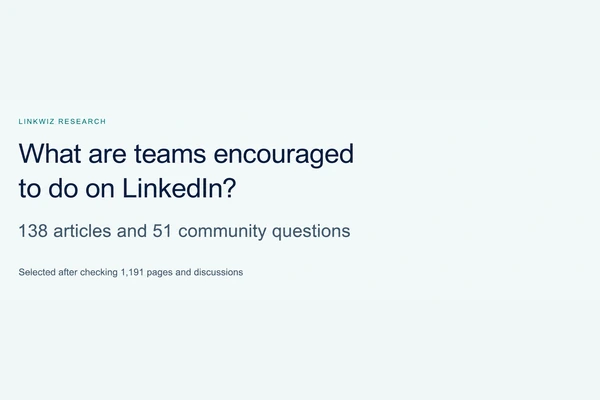
Our research on LinkedIn business advice found that 55 selected articles discussed public participation, but only one made it the main focus. This worked example shows how a leader could give that activity a place in a team review.
Explore the Activity Tracking demo, or read our comparison of 30 LinkedIn tools for how this reporting fits alongside outreach and advocacy software.